Pundayschool · Episode 6 companion
The Voicemail: a devotional for anyone who prays and hangs up
A quick devotional for busy people: 3 to 5 minutes, start to finish. Read it or listen to it, whichever fits your evening: after the day's list is finally out of your head, before you turn the lamp off. When you reach the bottom, you have done today's devotional.

This devotional, from Pundayschool Episode 6, "The Voicemail," teaches that prayer was never meant to be a one way message we leave and then hang up on. Its verse is Psalm 46:10: "Be still, and know that I am God" (KJV). We are usually fluent in the list and silent on the listening, so tonight's practice is small: after you finish your list, stay on the line for one minute and let God talk.
Before the beep: watch the short
Pundayschool · EP 06 · under a minute
The Voicemail
We rattle off a list and hang up. Then the phone rings straight back.
Ringing soon
The short has not gone out yet. The day it goes live at @pundayschool, the video will play right here. The devotional below stands on its own, so read on.
Coming to YouTube · TikTok · Instagram · Facebook
Picking up: reading Psalm 46:10
"Be still, and know that I am God."
Psalm 46:10, KJV
Prefer to listen?
The whole of Psalm 46, read aloud in the King James Version. About a minute and a quarter.
Picture the busiest, most ordinary prayer list in the world. Job. Health. That parking space from three weeks ago. The weight, without giving up dessert. Every red light on the way to work, green. And please, let this card not get declined. We say it fast, in a kitchen, in the car, at a shop counter, on the walk to the front door, then we say amen and hang up.

None of that is wrong to bring. God can handle a parking space and a weak moment with dessert. The trouble is not the list. The trouble is what happens next: the phone rings straight back, and we let it go to "bit busy." We treat prayer like a voicemail machine, a one way box for messages, when it was always meant to work the other way too.
Psalm 46 is a psalm about chaos. Nations rage, mountains fall into the sea, kingdoms crumble. And in the middle of all that noise, God does not shout louder. He interrupts with seven quiet words: "Be still, and know that I am God." The Hebrew word behind "be still" sits closer to "stop" or "let go" than "relax." God is not asking us to slow our breathing. He is asking us to stop talking long enough to notice he is still on the line.
That is the whole shift this devotional is asking for. Not a longer list. Not better words. Just a pause where we used to hang up.
Prayer isn't a mailbox. It's a room with two chairs.
On hold: honest questions
No one is grading this. Just three quiet questions, between us and God.

- When we pray, how much of it is genuinely a list, even a kind and honest one? What would it feel like to bring the exact same list, then stay quiet for as long as we spoke?
- What do we actually expect to happen in the silence after "amen"? If the honest answer is "nothing," where did that expectation come from?
- Think of the last time someone kept talking and never let us answer. What did that feel like? Is it possible we have done the same thing to God, more nights than we would like to admit?
Talk time: a short prayer
Pray it slowly, in these words or your own. Then stop talking.
Father, thank you that you are not a machine that only takes messages. Thank you that a call from me has never once gone to voicemail. Forgive me for the nights I have listed my requests and reached straight for the hang up. Teach me what it means to be still, not to relax, but to stop striving long enough to know that you are God. Tonight, after my list, keep me on the line. Amen.
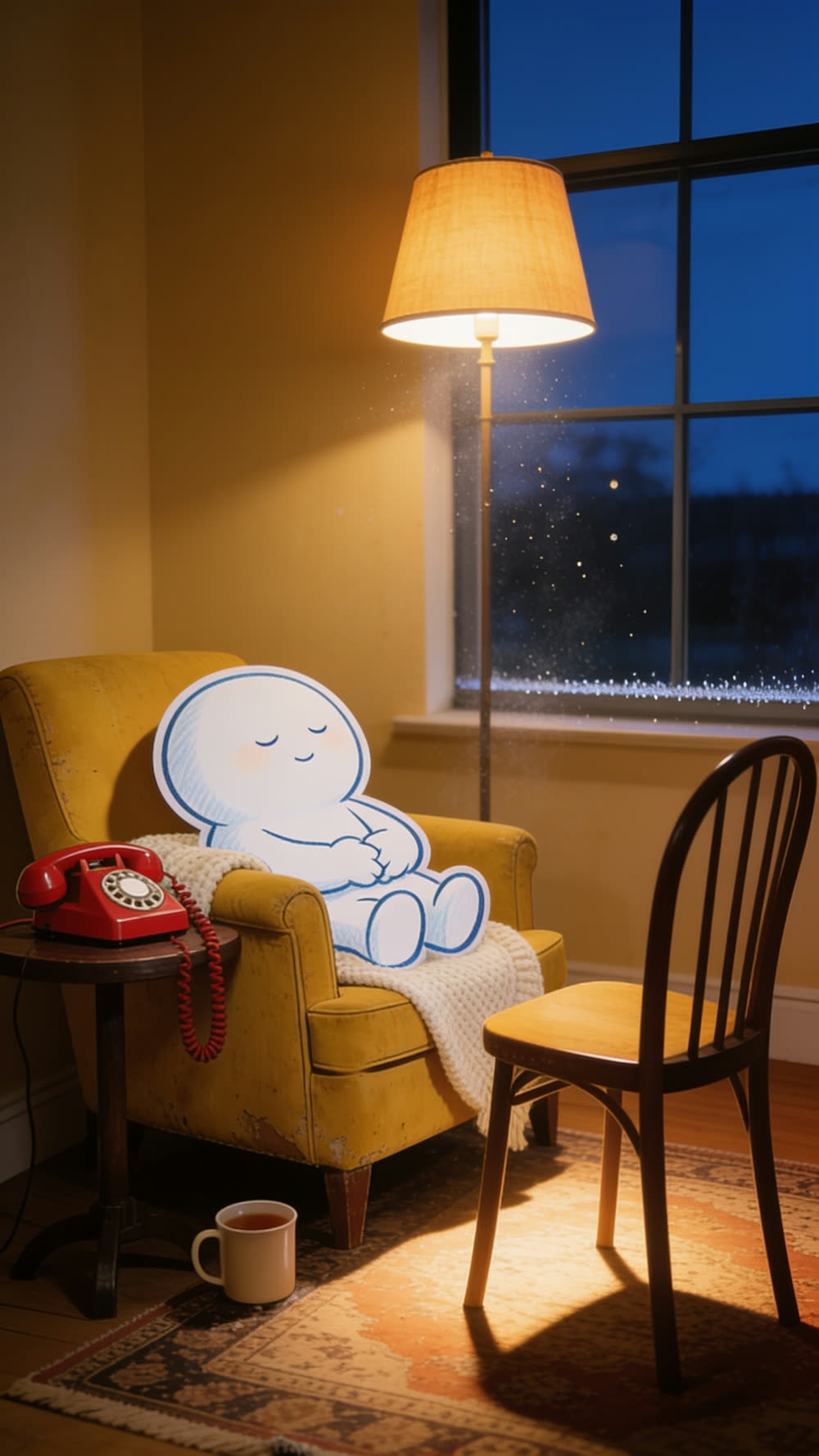
Before you hang up: one step for today
Tonight, after your list, however long or short it runs, do not reach for the hang up. Set a timer for one minute if that helps. Ten seconds is a real start if a minute feels like too much tonight. Just do not fill the silence with more words.
If your mind wanders back to the list, that is fine. Gently set it down again. You are not performing a technique. You are letting the other chair be sat in.
Line closed
That is the whole devotional. No extra reading, no follow up task, nothing to sign up for. If the silence felt strange tonight, that is normal, and it counts anyway. You have done today's devotional.
Messages people leave: questions people ask
What does Psalm 46:10 mean?
"Be still, and know that I am God" sits in the middle of a psalm about the world falling apart: nations raging, mountains shaking, kingdoms failing. God is not offering a breathing exercise. The Hebrew word behind "be still" means closer to "stop" or "let go" than "relax," and in its original setting it is God commanding warring nations to drop their weapons because he is God. Christians have long applied the same command inward, to our own striving, worrying, and list making.
Why do we treat prayer like a voicemail?
Because a list is easier than a conversation. Reading out requests takes a fixed amount of time and does not require us to wait for anything back. Actually listening does, and waiting in silence can feel uncomfortable, or even pointless, if we do not expect anything to happen there. The short's joke, praying our list then letting the call back go to "bit busy," names a habit most of us recognize once someone says it out loud.
How do I actually listen in prayer, practically?
Start smaller than feels useful. After you finish your list tonight, stay silent for ten seconds before you say amen. No technique required, just quiet. As that becomes normal, stretch it to a full minute. You are not fishing for a voice in your head. You are practicing the posture of someone who expects an answer, not just permission to speak.
What if I sit in silence and nothing happens?
That is common, and it does not mean the silence failed. Being still is an act of trust, not a technique for producing a feeling. Some nights it will seem like nothing happened. The practice still says something true either way: that we believe God is present and listening, whether or not we feel anything back.
Where can I watch The Voicemail?
Episode 6 goes live soon at @pundayschool on YouTube, TikTok, Instagram, and Facebook, and the video will be embedded at the top of this page the day it posts. Bookmark this page or follow @pundayschool to catch it first.