Pundayschool episode 1 companion · The Sunday Match
One Body, Many Parts: a 1 Corinthians 12 study guide
The fuller meal behind our 51 second short. Built for a small group evening or a personal hour with a journal. About 40 minutes together, 20 on your own, no seminary required.
- Passage
- 1 Corinthians 12:12-27, key verse 12:27
- Time
- About 40 minutes with a group, 20 solo
- You need
- A Bible, this page, something to write with
- Works for
- Small groups, youth groups, or one honest person and a journal

The short answer
1 Corinthians 12:27 teaches that the church is one living body made up of many different parts, and that every believer is one of those parts. Writing to a divided church in Corinth, Paul says, "Now you are the body of Christ, and each one of you is a part of it" (NIV). No Christian is meant to do everything, and no Christian is meant to do nothing. Every believer has a God-given role, and the body only works when each part does its share.
Kickoff · 1 min
First, the 51 second version
Episode 1 is live. Watch it above, or on YouTube, TikTok, Instagram and Facebook at @pundayschool.
Watch on YouTube ↗The premise · 2 min
Why a football match

The short imagines Sunday as the strangest fixture in world football. On the field, twenty two people are running everywhere at once: carrying cables, stacking chairs, teaching children, making coffee, leading worship. In the stands, ten thousand of us are watching closely, offering expert advice, and desperately needing some exercise. Then the whistle blows on the joke: "Church was never meant to be a spectator sport."
It is funny because it is us. And it turns out Paul got to this exact picture about two thousand years before we did, writing to a church that had turned gifting into a competitive sport. That letter is where this study lives.
Background · 5 min
What was going on in Corinth
Corinth was a rich, proud port city, rebuilt by Rome and obsessed with status. Everyone was climbing: patrons collected followers, speakers competed for applause, and your place in the pecking order was the most interesting thing about you.
The church there caught the same disease. They split into fan clubs behind celebrity teachers (1 Corinthians 1:12). The wealthy ate first at the Lord's Supper while the poor went hungry (chapter 11). And when it came to spiritual gifts, they had built a league table: the dramatic, visible gifts at the top, the quiet ones nowhere. Paul wrote this letter from Ephesus around AD 55, partly to answer their own question, "Now about the gifts of the Spirit" (12:1). Chapters 12 to 14 are his full reply.
Here is the detail that sharpens the whole passage. The "society as a body" metaphor was already famous in the Roman world, and politicians used it to tell ordinary people to stay quietly in their place so the important parts could flourish. Paul takes that well-worn picture and flips it. In Christ's body, he says, the parts that seem weaker are indispensable, and God gives greater honor to the parts that lack it (12:22-24). This is not a motivational poster about teamwork. It is surgery on a church that ranked people.
Read · 5 min
Read the passage: 1 Corinthians 12:12-27
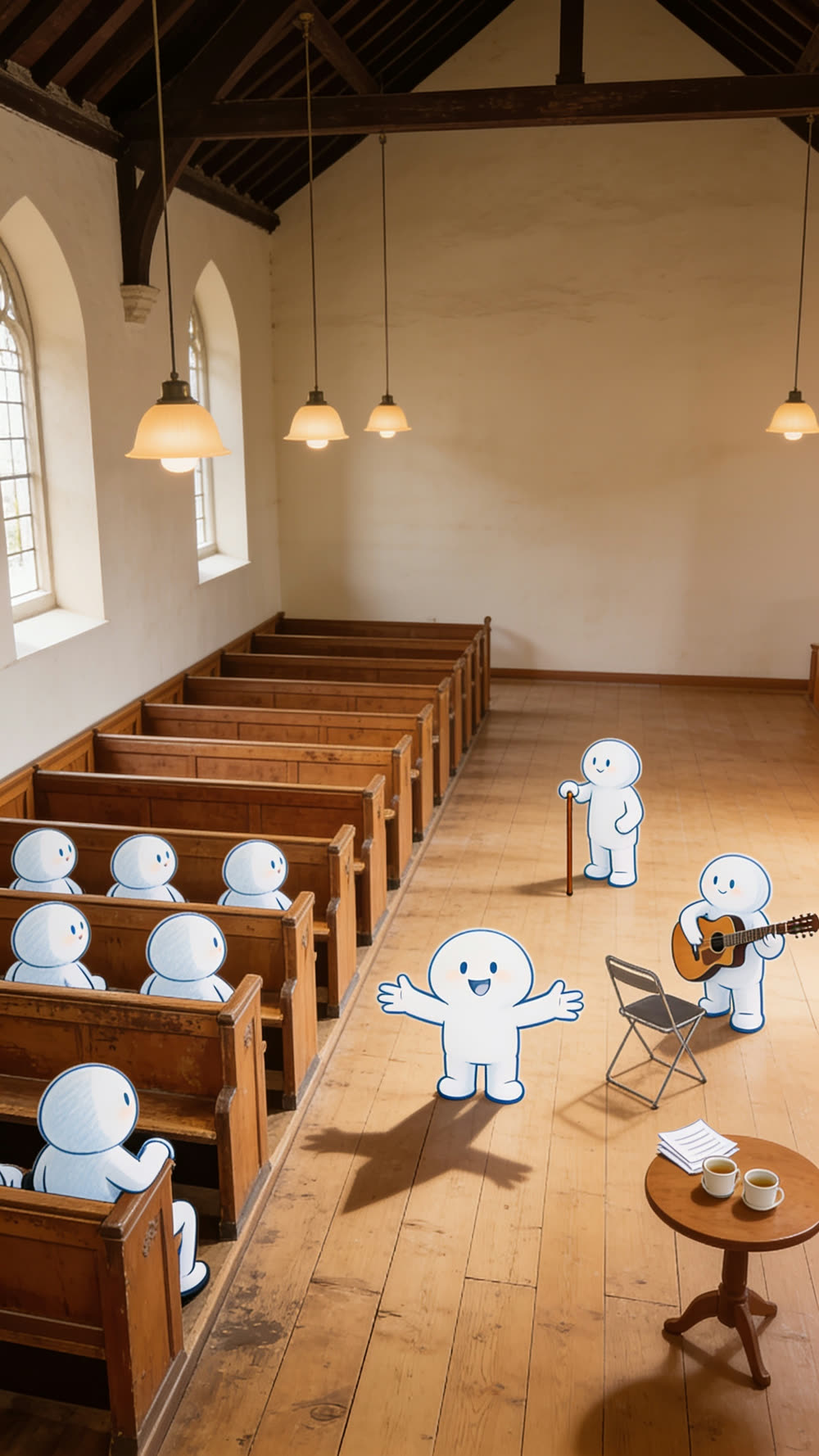
Have one person read the whole passage aloud while everyone else just listens. Then use this map to walk back through it.
- v12-14One body, many parts. The unity is not organizational, it is organic: one Spirit baptized us all into one body, whatever our background.
- v15-16The foot and the ear speak. This is the voice of feeling unnecessary: because I am not a hand, I must not belong.
- v17-20Paul's answer: a body that was all eye could not hear. God arranged the parts, every one of them, just as he wanted (v18). Difference is design, not accident.
- v21-24The eye and the head speak. This is the voice of self-sufficiency: I do not need you. Paul replies that the weaker-seeming parts are the ones the body cannot live without.
- v25-26The goal: equal concern for every part. One part suffers, every part suffers. One part is honored, every part celebrates.
- v27The whole argument lands on a direct address, and in Greek the "you" is plural: all of you together are the body, and each of you is a part.
"Now you are the body of Christ, and each one of you is a part of it."
1 Corinthians 12:27, NIV
Discuss · 20 min
Discussion questions

Warm up
keep it light, five minutes- Talk about a team, choir, kitchen, or crew where you knew exactly what your job was. What did having a clear part feel like?
- In the short, the crowd watches closely and offers expert advice. Where are we most tempted to be commentators rather than players, at church or anywhere else?
Into the text
give question 3 sixty seconds of quiet first- Read verses 15 and 16 again. The foot rules itself out because it is not a hand. What makes someone feel like a foot in a church full of hands? When have we felt that?
- Now verse 21. The eye tells the hand it is not needed. Which does more quiet damage in a church, parts that feel unnecessary or parts that feel self-sufficient? Where do we see each one?
- Verse 18 says God arranged the parts in the body, every one of them, just as he wanted. What changes if the mix of abilities we have is placement rather than accident?
- Paul insists the parts that seem weaker are indispensable (verse 22). Name the unseen work that keeps a church running. What would actually stop this Sunday without it?
The mirror
let the silence sit on question 7- Honestly, in this season, are we closer to the stands or to the player doing six jobs at once? What is that position costing us, or costing someone else?
- Verses 25 and 26 describe a body with equal concern for every part, where one part's pain is everyone's pain. When have we seen a church actually work like that? What made it possible?
- Verse 27 says each one of you is a part of it. If that is true of every person in the room, what part might be sitting unused right here tonight?
Go deeper · 4 min
Where else the Bible says this
Romans 12:3-8
The same metaphor, sent to a different city. Paul adds an instruction our passage assumes: measure yourself with sober judgment, neither inflated nor written off. Then he names gifts in plain clothes: serving, teaching, encouraging, giving, leading, showing mercy. Useful next to question 9, since most of these need no stage and no title.
Ephesians 4:11-16
This one corrects a common misreading. Pastors and teachers are not the players while the rest of us watch. Verse 12 says they exist to equip God's people for works of service, and verse 16 says the body grows as each part does its work. The staff are the coaching bench. The field is for everybody.
1 Peter 4:10
"Each of you should use whatever gift you have received to serve others" (NIV). Peter calls us faithful stewards of God's grace. A steward manages something on loan. Whatever we are good at was issued to us for the people around us.
Apply · 5 min
Put it into practice this week

The short ends with a swap. This Sunday, do not only ask "What did I receive?" Ask "Where can I serve?" Here is that question with legs on it.
1. Name your part
Take ten quiet minutes this week with three questions. What do people thank you for? What work makes you lose track of time? What need at church keeps catching your eye? Write three honest answers here:
2. Ask someone who knows you
Before next Sunday, ask one person who knows you well, "What do you think my part is?" Other people usually spot our gift years before we do.
3. Say yes to one small thing
One Sunday, one task, one shift on the sign-up sheet. Not a committee, not a title, not forever. A body finds out what a part is for by using it.
4. If you are already doing six jobs
Then your application runs the other way. Choose one thing to hand to someone else, and invite that person by name. An overworking part keeps another part on the bench, and the passage is against both.
To close
Father, thank you that the body of Christ has a place in it with our name on it. Show us our part, give us courage to play it, and grace to make room for the parts that are not like ours. Amen.
Full time
That's the guide

Print this, photocopy it, or read it again with a friend. Nothing to sign up for, nothing to remember. When the next episode drops, its study guide will sit right next to this one at pundayschool.com.
Extra time
Questions people ask about 1 Corinthians 12
What does 1 Corinthians 12:27 mean?
It is Paul's summary of his body metaphor. The "you" is plural, so all believers together form the body of Christ, while "each one of you" makes it personal: every single believer is a functioning part of that body. The verse rules out two errors at once, thinking the church does not need me, and thinking I do not need the church.
Why did Paul compare the church to a body?
The image was already famous in the ancient world. Roman speakers used the body to tell ordinary people to stay in their place and serve the important parts. Paul flips it: in Christ's body the parts that seem weaker are indispensable, God gives greater honor to the parts that lack it, and every part depends on every other part.
Is 1 Corinthians 12 about spiritual gifts or about serving in church?
Both, because Paul treats them as one subject. Verse 7 says each gift is given "for the common good," so a gift is not a personal possession but a job on the team. The chapter was written to a church that ranked flashy gifts above quiet ones, and its answer is that every gift exists to serve the body.
Can I use this study guide on my own?
Yes. Read the background, read the passage slowly, and treat the discussion questions as journal prompts. On your own the study takes about 20 minutes, and the write-in lines in the application section are there for exactly that.
How is being part of the body different from being a church member?
Membership can live on a list. A part is load-bearing: it has a function the rest of the body feels when it is missing. Since 1 Corinthians 12:27 says every believer is a part, the real question is not whether we belong but whether our part is in play.