Pundayschool episode 31 companion · The Speed-Walked Sabbath
Set Apart, Not Timed: an Exodus 20:8 study guide
The fuller meal behind our short. Built for a small group evening or a personal hour with a journal. About 40 minutes together, 20 on your own, no seminary required.
- Passage
- Exodus 20:8-11, key verse 20:8
- Time
- About 40 minutes with a group, 20 solo
- You need
- A Bible, this page, something to write with
- Works for
- Small groups, youth groups, or one honest person and a journal

The short answer
Exodus 20:8 is the fourth of the Ten Commandments: "Remember the Sabbath day by keeping it holy" (NIV). The verses that follow, 20:9-11, ground the command in God's own rest after creation and extend it to everyone in the household, not just the head of it. Holy means set apart, not squeezed in between two other tasks, and the command is to remember and keep it, not to measure or log it.
Cold open · 1 min
First, the short version
Pundayschool · EP 31 · 91 seconds
The Speed-Walked Sabbath
A candle lit in one second flat, a blanket snapped out like a matador's cape, and a phone timer clicking the whole time nobody was supposed to be racing.
Coming soon
Episode 31 has not posted yet. The short lands soon at @pundayschool on YouTube, TikTok, Instagram and Facebook, and the video will be embedded at the top of this page the day it posts. This study stands on its own, so feel free to start without it.
Coming to YouTube · TikTok · Instagram · Facebook
The premise · 2 min
Why a phone timer ruins a nap
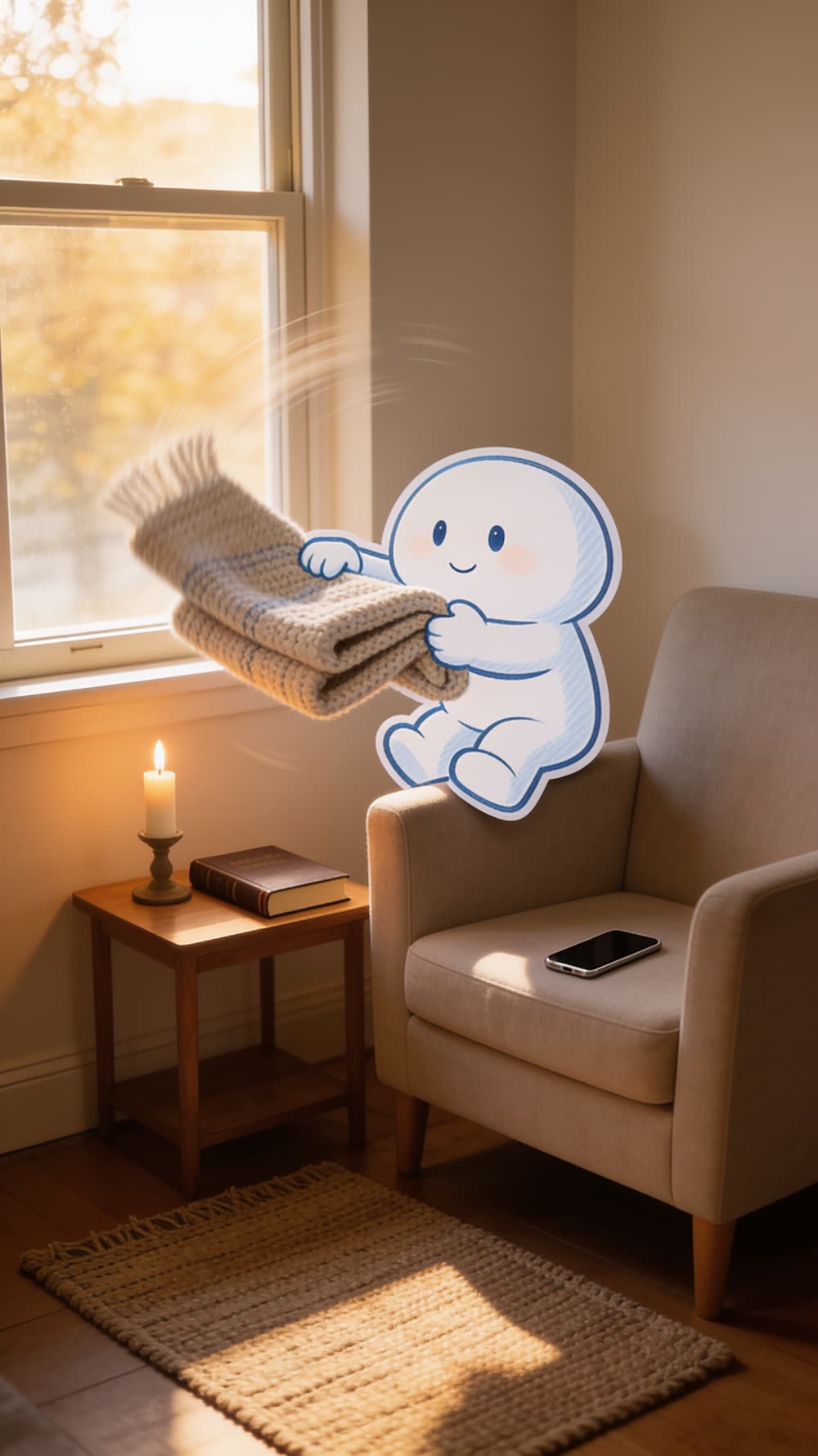
The short pictures one mascot with one good plan: rest, finally, on a quiet Sunday afternoon. Then the stopwatch mentality takes over anyway. The candle gets lit in one second flat. A book flips open to a random page, wisdom absorbed at speed. A blanket snaps out like a matador's cape and lands over the knees right on schedule, tension released on time, while a phone timer keeps clicking away the whole afternoon.
The mascot surfaces with the phone held aloft like a trophy: "I have successfully rested in under four minutes." Then the grin falters, because the only slow thing all afternoon was admitting why the timer was ever running. Exodus 20:8 is the episode's real center of gravity: a command to remember the Sabbath by keeping it holy, given long before anyone thought to time how well they kept it.
Background · 6 min
Where Exodus 20:8 sits in its story
Exodus 20 records the Ten Commandments, given to Israel at Mount Sinai not long after God brought them out of slavery in Egypt. The first three commandments are about God himself: no other gods, no idols, no misusing his name. The fourth, the Sabbath command, is the hinge of the list. It is also the longest of the ten by far, and the only one that comes with its own built-in reason attached, rather than standing as a bare instruction.
Verse 9 sets the pattern: six days you shall labor and do all your work. Verse 10 names the day: the seventh is a Sabbath to the LORD. Then verse 10 keeps going, listing who the rest applies to: sons, daughters, male and female servants, animals, even the foreigner living in the towns. Nobody in the household is exempt, including the people with the least power to claim rest for themselves. This is not a rest a household's most important person alone gets to enjoy while everyone else keeps working.
Verse 11 gives the reason: "For in six days the LORD made the heavens and the earth, the sea, and all that is in them, but he rested on the seventh day. Therefore the LORD blessed the Sabbath day and made it holy." The command is not arbitrary. It is stitched into the same rhythm God himself used at creation, before there was any commandment to keep and before anyone had proven anything by working hard. Rest, in other words, was written into the pattern of the world before there was a stopwatch to measure it against.
Read · 5 min
Read the passage: Exodus 20:8-11

Have one person read the whole passage aloud while everyone else just listens. Then use this map to walk back through it.
- v8The command itself: remember the Sabbath day by keeping it holy. Set apart, not squeezed in.
- v9The six-day pattern: six days you shall labor and do all your work.
- v10The seventh day belongs to the LORD, and the rest extends to everyone in the household: children, servants, animals, even the foreigner in the towns.
- v11The reason: God made everything in six days and rested the seventh, so he blessed the Sabbath day and made it holy.
"Remember the Sabbath day by keeping it holy."
Exodus 20:8, NIV
Discuss · 20 min
Discussion questions

Warm up
keep it light, five minutes- Describe a time you turned something restful into a task to finish quickly. What gave it away: a timer, a checklist, something else?
- The short's mascot never decides to race through rest on purpose, it just happens. Why do you think that habit sneaks up on us rather than announcing itself?
Into the text
give question 4 sixty seconds of quiet first- Verse 10 lists sons, daughters, servants, animals, and foreigners as all covered by the Sabbath rest. What does it change to see rest as something fenced around everyone, not a privilege only the person in charge gets to keep?
- Verse 11 grounds the command in God's own rest at creation, before there was any commandment yet to obey. What difference does it make that rest came before the rule about rest?
- The command says "remember... by keeping it holy," not "remember to log it." What is the difference between keeping something and proving you kept it?
Timers and trust
let the silence sit on question 7- The episode's heart-turn is this: "even rest has to prove itself before we trust it, so we time it, log it, and move on." Where has that been true for you this month?
- What would it look like this week to let one period of rest run long, on purpose, with nothing timing it or grading it afterward?
- The short's closing line is: "You don't earn the Sabbath. You just keep it." What would change if you actually believed that about your own rest this week?
Go deeper · 4 min
Where else the Bible says this
Genesis 2:2-3
"By the seventh day God had finished the work he had been doing; so on the seventh day he rested from all his work. Then God blessed the seventh day and made it holy, because on it he rested from all the work of creating that he had done." This is the pattern Exodus 20:11 points back to: rest built into creation itself, blessed and made holy before there was a single human being to keep the command.
Mark 2:27
"The Sabbath was made for man, not man for the Sabbath." Jesus says this after religious leaders accuse his disciples of breaking the Sabbath by picking grain to eat. The Sabbath is a gift handed to people, not a performance owed back to God. A rest that has to be timed, logged, and defended has quietly flipped which direction that gift was meant to travel.
Hebrews 4:9-11
"There remains, then, a Sabbath-rest for the people of God; for anyone who enters God's rest also rests from their works, just as God did from his. Let us, therefore, make every effort to enter that rest." The weekly Sabbath points forward to a deeper rest: ceasing from our own works the way God ceased from his. It is entered, not earned, which is the same shape as the episode's own closing line.
Apply · 5 min
Put it into practice this week
The short ends with an instruction plain enough to carry into the week: put the timer down, and stay a while. Here is that instruction with legs on it.
1. Name your own stopwatch
What is the specific way you time, log, or measure your own rest, even informally? A step count, a screen-time report, a mental tally of how "productive" the break was? Write down the real, specific thing:
2. Pick one rest this week with nothing timing it
Choose one period this week, ten minutes or an hour, and decide in advance that nothing will measure it. No screen, no step count, no mental scorecard at the end. Let it run exactly as long as it needs to.
3. Let someone else's rest count too
Verse 10 extends rest to everyone in the household, not just the person in charge. Notice one person this week whose rest you could protect rather than quietly interrupt or question.
4. A word for real, busy weeks
This is not about achieving a perfectly restful life. Some weeks barely have room for the ten minutes. The passage's own remedy is not a bigger performance of rest, it is trusting that a Sabbath kept, however small, still counts, because it was never something to earn in the first place.
To close
Father, thank you that you rested before you ever asked us to. Forgive us for turning your gift into another task to finish and prove. Thank you that holy means set apart, not squeezed in between two other things. Help us put down whatever stopwatch we are carrying, and let the moment run long. Thank you that we do not earn the Sabbath. We just get to keep it. Amen.
Reading taken
That's the guide
Print this, photocopy it, or read it again with a friend. Nothing to sign up for, nothing to remember. When the next episode drops, its study guide will sit right next to this one at pundayschool.com.
Extra time
Questions people ask about Exodus 20:8
What does Exodus 20:8 mean?
Exodus 20:8 says, "Remember the Sabbath day by keeping it holy" (NIV). It is the fourth of the Ten Commandments, and "holy" means set apart: a day marked off from ordinary work, not a task to clear as fast as possible. The verses that follow, 20:9-11, ground the command in God's own rest after creation.
What is the context of Exodus 20:8-11?
Exodus 20 records the Ten Commandments, given to Israel at Mount Sinai shortly after their exodus from slavery in Egypt. The Sabbath command is the fourth and the longest of the ten, and unlike a purely moral command, it comes with its own built-in reason: verse 11 ties it directly back to the creation account, where God worked six days and rested the seventh.
Why does the Sabbath command include servants and animals?
Exodus 20:10 extends the command to sons, daughters, male and female servants, animals, and foreigners living in the towns. Rest in this command is not a private luxury only the head of the household can afford; it is fenced around everyone under that household's authority, including the people with the least power to claim it for themselves.
How does The Speed-Walked Sabbath use Exodus 20:8?
The episode pictures a mascot who sprints through an afternoon of rest, timing every step with a phone until the punchline lands: "I have successfully rested in under four minutes." Exodus 20:8 supplies the correction: the command is to remember the Sabbath by keeping it holy, not by logging it. Rest that has to prove itself with a stopwatch has already missed the point.
Is this study saying rest has to look a certain way?
No. The command sets apart a rhythm, not a formula for exactly how the time gets spent. The corrective in both the episode and this study is about trust, not technique: letting a period of rest count without needing to measure, log, or perform it first.