Pundayschool episode 39 companion · The Car Radio Verse
Turn It Back Up: a Psalm 33:3 study guide
The fuller meal behind our short. Built for a small group evening or a personal half hour with a journal. About 30 minutes together, 15 on your own, no seminary required.
- Passage
- Psalm 33:3
- Time
- About 30 minutes with a group, 15 solo
- You need
- A Bible, this page, something to write with
- Works for
- Small groups, youth groups, or one honest hour with a journal

The short answer
Psalm 33:3 is part of a call to worship: "Sing to him a new song; play skillfully, and shout for joy" (NIV). It asks for fresh, wholehearted praise, not a repeat of what's already comfortable and mastered. Staying fully engaged on the familiar part while quietly turning ourselves down the moment something new is asked of us misses the verse's whole point - it wants a new song, sung out loud.
Press play · 2 min
First, the short version
"The Car Radio Verse" is on its way. Once Episode 39 is posted, it will play right here. In the meantime, find Pundayschool on YouTube, TikTok, Instagram, and Facebook at @pundayschool.
The setup · 2 min
Why the radio, and why the volume knob
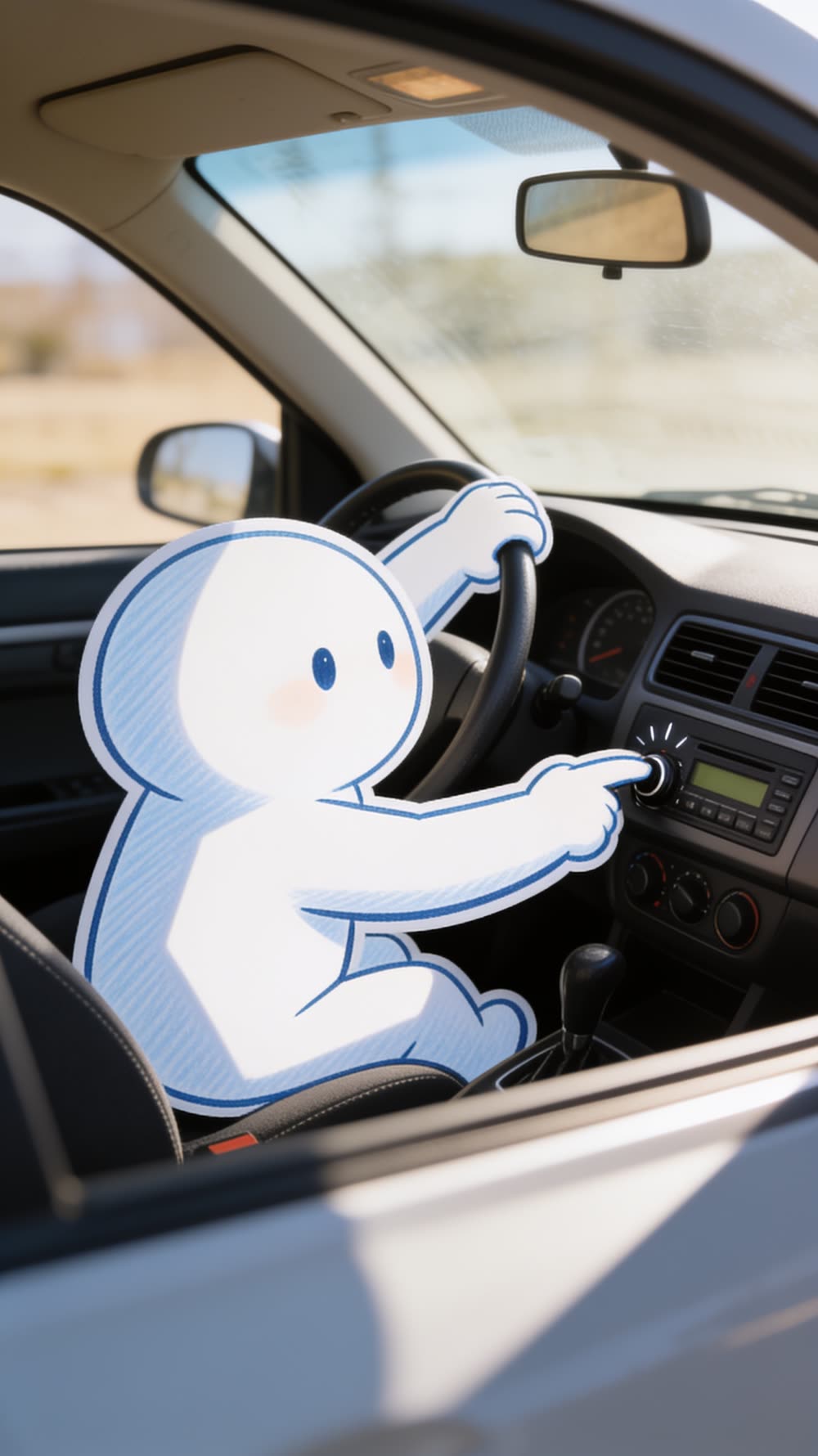
The short pictures a mascot driving along, radio up, singing a favorite chorus word-perfect at full volume. Then an unfamiliar verse comes on - the melody climbs somewhere it's never been - and its hand shoots for the volume knob. It doesn't stop the song. It just mouths along in near-silence, still present, just protected from being heard getting it wrong.
The gag is entirely physical, but the feeling underneath it is exactly the same as the spiritual habit 3 John's cousin verse points at: staying fully engaged right up until something asks more of us than the comfortable part we've already got down, then quietly turning ourselves down instead of an honest engagement or an honest no.
Background · 5 min
A psalm built entirely as an invitation to worship
Psalm 33 has no title or attributed author in the Hebrew text, and it reads as a direct continuation of Psalm 32's closing call to "shout for joy." The whole psalm is structured as an invitation: verses 1-3 call the righteous to praise with instruments and voice, verses 4-19 give the reasons (God's word is right, his works are faithful, he sees and cares for those who fear him), and verses 20-22 close with trust and hope placed in him.
Verse 3's "new song" isn't a one-off phrase - it appears repeatedly across the Psalms (33:3, 40:3, 96:1, 98:1, 144:9, 149:1) as a recurring picture of worship that responds freshly to what God has newly done, rather than only reciting what's already familiar. Paired with "play skillfully" and "shout for joy," the verse pictures effort and volume together: real skill applied, and real, unrestrained sound - not a quiet, careful offering.
Read against that backdrop, the verse isn't really about music at all - it's about the posture of worship itself: fresh, wholehearted, unafraid of getting the new part wrong.
Read · 4 min
Read the verse: Psalm 33:3

Have one person read the verse aloud slowly, in more than one translation if you have them. Then use this map to walk back through its three short phrases.
- "Sing to him a new song"Fresh praise, not a repeat of the familiar - the turn the whole episode is built on.
- "Play skillfully"Real effort applied, not a half-hearted or careless offering.
- "Shout for joy"Real volume - unrestrained, not a cautious murmur kept quiet enough to stay safe.
"Sing to him a new song; play skillfully, and shout for joy."
Psalm 33:3, NIV
Discuss · 15 min
Discussion questions

Warm up
keep it light, five minutes- Tell the group about something you were once fully confident doing, right up until it suddenly asked more of you than you expected.
Into the text
read the verse in two translations before question 3- The verse asks for a "new song," not a repeat of the familiar one. What does it mean, practically, to bring the same wholehearted effort to something unfamiliar in faith that we bring to what we already know well?
- Psalm 33:3 pairs skill and volume - "play skillfully" and "shout for joy." Why do you think both matter together, rather than either one alone?
- The episode's mascot doesn't stop engaging entirely when the song gets hard - it just goes quiet while still technically participating. Why might that quieter kind of retreat be easier to miss, in ourselves or others, than a full walkout?
The mirror
let the silence sit on the last question- Honestly, where in your own faith do you find yourself "turning down the volume" - still present, but protecting yourself from being heard getting something wrong?
- What would it cost you to turn that back up this week, out loud, wrong notes and all?
Go deeper · 4 min
Where else the Bible says this
Psalm 96:1
"Sing to the LORD a new song; sing to the LORD, all the earth" (NIV). The same call to fresh worship, widened to include everyone, not just the already-confident.
2 Timothy 1:7
"For the Spirit God gave us does not make us timid, but gives us power, love and self-discipline" (NIV). A direct answer to the fear of getting the new part wrong - timidity isn't the posture we're handed.
Hebrews 13:15
"Through Jesus, therefore, let us continually offer to God a sacrifice of praise - the fruit of lips that openly profess his name" (NIV). Worship described as something spoken openly, not muted or kept safely quiet.
Apply · 5 min
Put it into practice this week
The short ends with the smallest possible action: the mascot reaches for the knob again, and turns it back up. Here is that same small step, with legs on it.
1. Name the knob
Write down the specific part of faith you tend to quietly mute - a prayer, a question, a step you've avoided taking out loud. Use the space below:
2. Name the volume
Write the literal, specific way you'd turn it back up - one real action, not a vague intention.
3. Turn it up
Before the week's out, do that one thing out loud. Then tell one other person you did.
To close
Father, thank you that you never ask for a quieter version of us, only a fuller one. Forgive me for the parts I've quietly muted rather than risk getting them wrong. Give me the small courage to turn the volume back up. Amen.
The end
That's the guide
Print this, photocopy it, or read it again with a friend. Nothing to sign up for, nothing to remember. When the next episode drops, its study guide will sit right next to this one at pundayschool.com.
Extra time
Questions people ask about Psalm 33:3
What does Psalm 33:3 mean?
It's part of a psalm calling God's people to praise, and it specifically asks for "a new song" - fresh, wholehearted worship rather than only a repeat of the familiar - offered with real skill and real volume, not a cautious or quiet performance.
Why does the psalm ask for a "new" song specifically?
The phrase recurs across the Psalms as a picture of worship that responds freshly to God, not just recites what's already comfortable. It's an invitation to bring the same wholehearted engagement to the new and unfamiliar that we bring to what we've already mastered.
Is it wrong to enjoy familiar worship songs or familiar prayers?
No - the issue in this study isn't the familiar itself, it's when the familiar becomes the only thing we're willing to bring full voice to, while everything unfamiliar gets quietly muted instead of genuinely engaged.
What if I don't know what my own "new song" is yet?
Start with whatever you were about to avoid today - a hard conversation, an unfamiliar prayer, a step you've been putting off. The new song is rarely abstract; it's usually the specific thing already in front of you.
Where can I watch The Car Radio Verse?
Right at the top of this page once it is live, or on YouTube, TikTok, Instagram, and Facebook at @pundayschool.