Pundayschool episode 6 companion · The Voicemail
Stay On the Line: a Psalm 46:10 study guide
The fuller meal behind our under-a-minute short. Built for a small group evening or a personal half hour with a journal. About 40 minutes together, 20 on your own, no seminary required.
- Passage
- Psalm 46, key verse 46:10
- Time
- About 40 minutes with a group, 20 solo
- You need
- A Bible, this page, something to write with
- Works for
- Small groups, youth groups, or one honest person and a journal

The short answer
Psalm 46:10, "Be still, and know that I am God," is God's own interruption in the middle of a psalm about international chaos: nations raging, mountains falling into the sea, kingdoms collapsing. It is not a gentle suggestion to relax. The Hebrew command behind "be still" means closer to "stop striving" or "let go" than "calm down," and God first speaks it to warring nations, telling them to drop their weapons because he is God. Applied to prayer, it means we were never meant to only talk. Prayer is a conversation, and being still is how we finally let the other side speak.
Before the beep · 1 min
First, the under-a-minute version
Episode 6 hasn't rung yet. The Voicemail lands soon at @pundayschool on YouTube, TikTok, Instagram and Facebook. This study stands on its own, so feel free to start without it.
The premise · 2 min
Why a voicemail

The short imagines a familiar habit: we sit down, dial in a list, and get through it fast. Job. Health. That parking space from three weeks ago. The weight, without giving up dessert. Every red light between here and work, green. And please, do not let this card decline. Amen. Bye. Then the phone rings straight back, and we let it go to "bit busy."
It is funny because it is us. Most of us have prayed a list and reached for the hang up before God got a word in. And it turns out the psalms got there first, with a single line that still stops a room: "Be still, and know that I am God." That verse is where this study lives.
Background · 5 min
What is going on in Psalm 46
Psalm 46 is credited to "the sons of Korah," a family of Levite singers who led worship in Israel for generations. The psalm itself never names an event, but its confident, almost triumphant tone has long led readers to connect it with a moment when Jerusalem was under real threat and was unexpectedly delivered, the kind of story told in 2 Kings 19. Whether or not that is the exact occasion, the psalm is built for a city that has watched the ground actually shake.
The whole psalm moves in three waves, each one closed by the word "Selah," a pause marker for the original singers and musicians. First, creation itself seems to fail: the earth is removed, the mountains are carried into the sea (verses 1 to 3). Then a quieter picture appears, a river bringing gladness to the city of God, steady while everything else shakes (verses 4 to 7). Finally God himself steps in and makes the wars stop (verses 8 to 11). Twice, in verses 7 and 11, the psalm repeats the same refrain like a chorus: "The Lord of hosts is with us; the God of Jacob is our refuge."
Here is the detail that sharpens verse 10. "Be still" translates a Hebrew word, raphah, that means to slacken, let drop, or stop striving, closer to "stand down" than "relax." In its setting, God is not speaking gently to one worried person. He is speaking to raging nations and their armies, in the same breath as breaking bows and burning chariots (verse 9), and telling them to drop their weapons because he is God. It is worth knowing, too, that Martin Luther leaned on this exact psalm when he wrote the hymn "A Mighty Fortress Is Our God," a song built entirely on the idea of a stronghold that does not shake even when everything else does.
Read · 5 min
Read the passage: Psalm 46

Have one person read the whole psalm aloud while everyone else just listens. Then use this map to walk back through it.
- v1The opening claim: God is our refuge and strength, a very present help in trouble. Not a distant help. Present, right now, in this trouble.
- v2-3The worst case, named out loud: the earth removed, mountains carried into the sea. Even then, "we will not fear." Selah.
- v4-5A river runs through the city of God, making it glad, while everything outside shakes. "She shall not be moved: God shall help her, and that right early."
- v6-7Nations rage, kingdoms are moved, God simply speaks and the earth melts. First refrain: "The Lord of hosts is with us; the God of Jacob is our refuge." Selah.
- v8-9An invitation: come and see what God has done. He is the one who ends wars, not us, and not our striving.
- v10The line the whole psalm has been building toward: "Be still, and know that I am God." A command to stop, not a suggestion to unwind.
- v11The refrain returns, closing the psalm exactly where it opened: God with us, God our refuge. Selah.
"Be still, and know that I am God."
Psalm 46:10, KJV
Discuss · 20 min
Discussion questions

Warm up
keep it light, five minutes- Talk about the last few things you actually prayed about today or this week. How much of it was a list, even a completely honest one?
- In the short, the list moves from the kitchen to the car to the shop to the front door. Where does prayer tend to happen for us, mid-task or set apart?
Into the text
give question 5 sixty seconds of quiet first- Read verses 1 to 3 again. The psalm names the worst case, the earth itself giving way, before it says "we will not fear." What changes when we name the fear honestly instead of praying around it?
- Verse 10 says "be still," a word closer to "stop striving" than "relax," spoken first to raging nations and armies. Why might God choose that image, warring nations, rather than a tired individual, to introduce this command?
- The refrain in verses 7 and 11 repeats word for word: "The Lord of hosts is with us." Why might a psalm about chaos need to say the same reassurance twice rather than once?
- Verses 8 and 9 say God is the one who makes wars cease, not us. What is the difference between striving to fix something ourselves and being still enough to let God act?
- Honestly, when we finish praying, what do we usually do next? Is there room, right there, for ten seconds where we do not do anything next?
The mirror
let the silence sit on question 7- The short's punchline is that we let the call back go to "bit busy." What is the "bit busy" we usually reach for right after we pray?
- If prayer is a room with two chairs, which chair have we mostly been using this season? What would it look like to actually sit in the silence long enough to notice the other one?
Go deeper · 4 min
Where else the Bible says this
Matthew 6:7-8
Jesus warns against "vain repetitions," babbling on as though God only hears us if we keep talking, and then says the opposite: "your Father knoweth what things ye have need of, before ye ask him." If God already knows the list, prayer was never only about getting the words out. Useful next to the discussion's warm up question.
Habakkuk 2:20
"But the Lord is in his holy temple: let all the earth keep silence before him." A short companion verse to Psalm 46:10, aimed the same direction: silence is not absence, it is the appropriate response to being in God's presence.
James 4:8
"Draw nigh to God, and he will draw nigh to you." A promise that answers the fear behind the whole habit of hanging up early: coming close is not wasted effort. God moves toward us in it, not away.
Apply · 5 min
Put it into practice this week
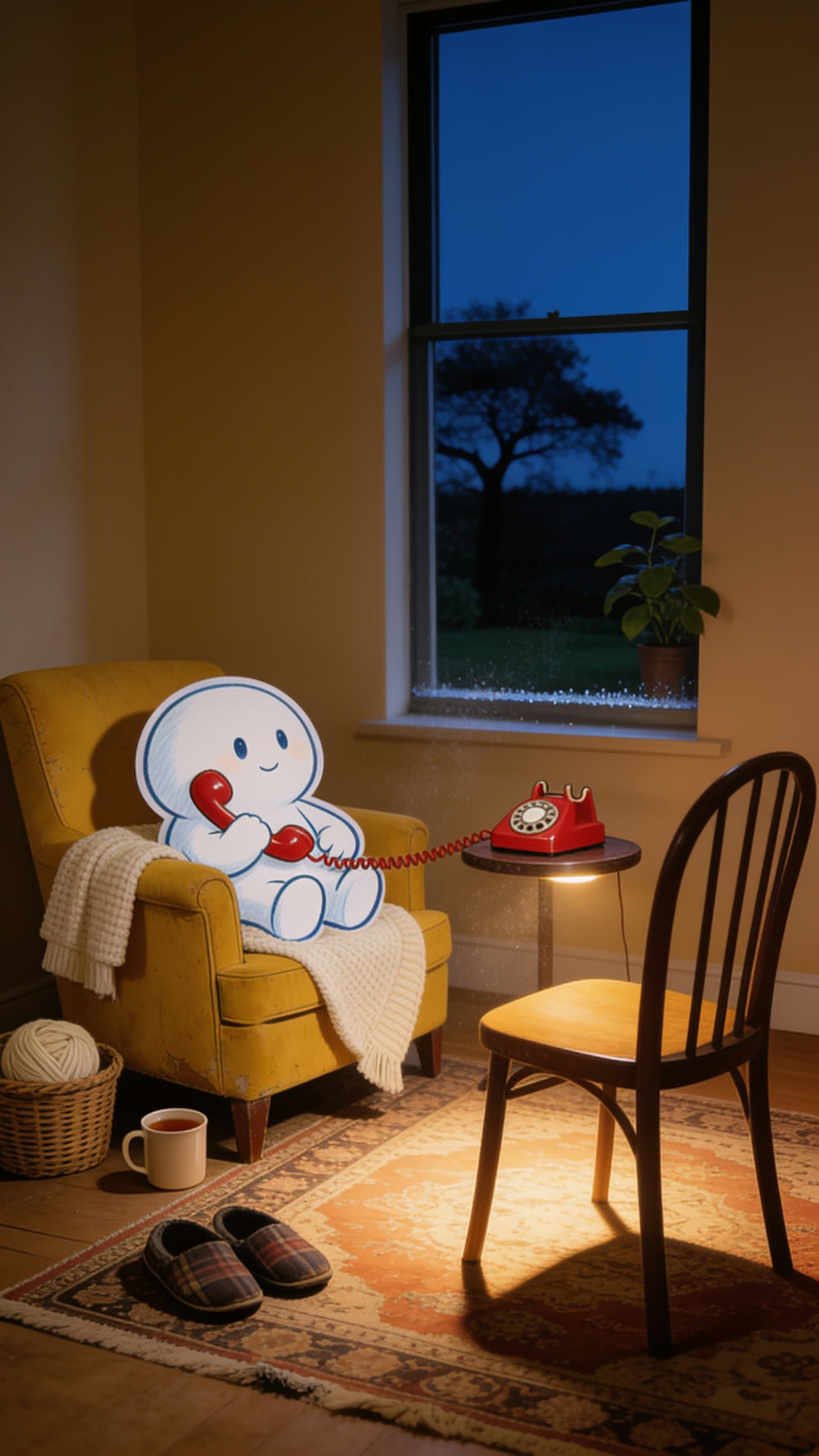
The short ends with a swap. Tonight, after the list, do not reach for the hang up. Here is that swap with legs on it.
1. Name the list you actually pray
Take five quiet minutes this week and write down the requests that come up most often. Not the requests you think you should bring, the ones you actually bring. Write three or four here:
2. Try ten seconds tonight
After your list, before you say amen, stay silent for a slow count of ten. No technique, just quiet. Notice what your mind does with the space.
3. Stretch it to a minute this week
Once ten seconds feels normal, try a full minute one evening this week. Set a timer if that helps you stop watching the clock.
4. If silence already comes easily to you
Then your application runs the other way. Ask someone in the group how their week of silence went, and actually listen to the answer without filling the pause. Practicing the other chair works both directions.
To close
Father, thank you that you are not a machine that only takes messages. Teach us what it means to be still, not to relax, but to stop striving long enough to know that you are God. Keep us on the line tonight, and every night after the list runs out. Amen.
Line closed
That's the guide

Print this, photocopy it, or read it again with a friend. Nothing to sign up for, nothing to remember. When the next episode drops, its study guide will sit right next to this one at pundayschool.com.
Extra time
Questions people ask about Psalm 46:10
What does Psalm 46:10 mean?
"Be still, and know that I am God" is God's own interruption in the middle of a psalm about nations raging and the earth shaking. The Hebrew word behind "be still" means closer to "stop striving" or "let go" than "relax." First addressed to warring nations, the verse tells them to drop their weapons because God is God. Applied personally, it is an invitation to stop our own striving, including our habit of only ever talking, long enough to know he is present.
Is Psalm 46:10 about relaxing or about something else?
Something else, mostly. Modern readers often hear "be still" as a call to calm down or breathe slowly, and there is nothing wrong with applying it that way personally. But in context it is a command, closer to "stand down" or "stop," spoken to armies and kingdoms in the middle of a psalm about chaos, not a quiet suggestion to a stressed individual.
Why is Psalm 46 connected to the hymn "A Mighty Fortress Is Our God"?
Martin Luther drew directly on this psalm's picture of God as an unshakable refuge when he wrote the hymn, one of the most well known in church history. The psalm's confidence, that God remains a fortress even while the earth and its kingdoms shake, is the whole engine of the song.
Can I use this study guide on my own?
Yes. Read the background, read the passage slowly, and treat the discussion questions as journal prompts. On your own the study takes about 20 minutes, and the write-in lines in the application section are there for exactly that.
Where can I watch The Voicemail?
Episode 6 goes live soon at @pundayschool on YouTube, TikTok, Instagram, and Facebook, and the video will be embedded near the top of this page the day it posts. Bookmark this page or follow @pundayschool to catch it first.